Interview with Glenn Hegedus

Public art rarely operates at the scale, complexity and permanence of major infrastructure. Along Western Australia’s Albany Ring Road, artist Glenn Hegedus of Archetype Projects has delivered a monumental series of bridge artworks that respond directly to the geology, culture and stories of the Great Southern landscape.
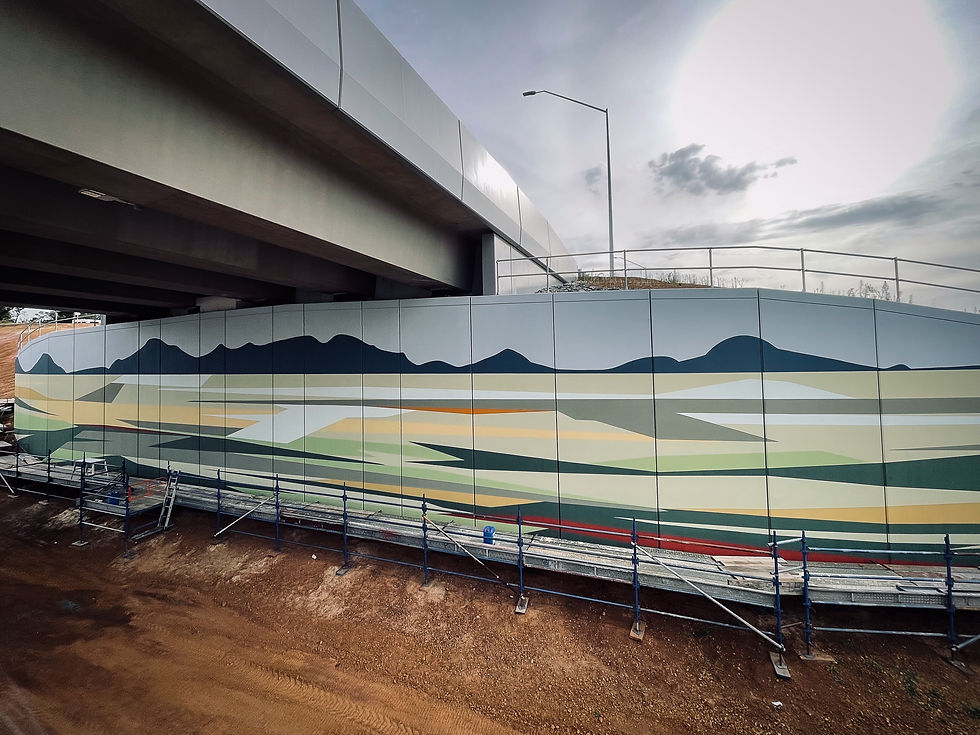
Working across multiple bridge structures for Main Roads Western Australia, Hegedus developed a design language informed by local rock formations, the shifting coastal environment of Princess Royal Harbour, and consultation with Menang Noongar knowledge holders. The result is a series of place markers embedded within the infrastructure itself, transforming raw concrete into a visual narrative of country.
Executed across thousands of square metres of surface, the project also explored an unconventional material approach for public art at this scale: mineral-based paint systems. In the interview below, Hegedus shares how the concept evolved, the challenges of applying mineral paints across vast bridge structures, and why the material became central to the project’s longevity and environmental ambitions.
What was the design intent of your client for this project? And what was your input into their design process?
MRWA indicated an intent for design that was relevant to the great southern environment, its people and rich history that created place markers way points of navigation in an aesthetic outcome that was also appropriate for a major vehicle thoroughfare.
This started for me with an extensive research endeavour working with a Menang Noongar man to broaden the scope of my local knowledge and stories. We spent time on country and the folklore shared as well the associated geography informed the fundamentals of my design intent. From there detailed design proposal documents were drafted for review towards completed plans for installation.

What initially drew you to use KEIM mineral paints for the Albany Ring Road bridges compared to other paint systems?
I’ve always been drawn to explore new and innovative materials for public art applications as well as being up to a challenge of a new installation methodology. Stone and earth is referenced heavily within my initial design briefs and after researching options, an earth based mineral treatment long proved for specific characteristics appeared to be a worthy solution this along with the spectrum of hues available. The added bonus of an extraordinarily flat and matte finish became a fundamental point from which my objectives for this project were developed.
How familiar were you with KEIM prior to this project? How had you heard about us?
I was not familiar with Keim, at all. I remember seeing the logo associated with Guido Van Helton’s portraiture however had no knowledge of the products composition or source. There have been buildings that I’ve seen with the painted treatment and wondered - how did they do that? Discovering Keim became a little bit of an ‘aha’ moment.
Were there any challenges or surprises in working with mineral paints at this scale?
There were many. And being completely new to the product, it was a humbling bump in the first days of the install. Small scale tests and techniques in the studio did not translate to what was required for a large vertical surface. Like needing to forget everything already leaned and interpret it as printing, instead of painting. Different colours and pigments behaved with differently also. It all kept us on our toes with adaptation, problem solving and flexibility an important part of every day.
Can you speak to the environmental conditions of this project, such as coastal winds, sun exposure, and rainfall - and how this influenced your design/spec approach?
The Great Southern of Western Australia is a raw and wild part of the world. Albany is known for having four seasons in a day. The weather can change quick and you learn to roll with whatever comes. To be honest, I love it. And although it can make the larger installs and scheduling problematic it’s a beautiful part of the world to call home. The wind is warm from the north and east, crisp and fresh from the south and west. With a clear sky the sun bites beyond what you expect it would, and with cloud cover and moody hues its an environment of high humidity. A benefit of the muted spectrums of Keim made it easy to tailor a scheme to all seasonal environments. This of course is always a point of consideration for any site specific installations.

Were there any sustainability targets or standards that you aspired to for this project? What does this mean to you professionally?
The environmental and sustainability benchmarks for this projects’ application materials were based around the responsible, and common use of petroleum based acrylic treatments. Being able to deliver an outcome that could circumvent this industry acceptable and benign constant in our built environments, placed high within values to me personally, and professionally. It was easy to stand with conviction to the case for this products’ incursion in place of the long-standing and accepted artwork installation methodology for civil construction projects
Did the technical properties of KEIM influence your choice of colours, textures, or application methods?
Ignorance – was total bliss

How did you coordinate the application of KEIM across such large concrete surfaces – were there any logistical insights you can share?
It was fortunate that the bridge abutments were comprised of precast concrete panels that were around 2 ½ - 3 m wide and up to 9 m tall. That meant that within the design schematic there were natural breaks in the precast construction joints. These points of respite allowed for manageable areas to focus on, and complete individually to a high uniform and consistent finish. The sections of colour that extended to the entire height of an abutment, meant fast hands and high preparation - sometimes a man from the ground with an extension pole and a man in the basket for the upper half of the panel. Chasing a wet edge in the heat was little, to no fun. We capitulated the days for a period over summer and chose to start work at 6pm in the evening instead working through the night. An added bonus being the roadway was considerably quieter with way less freight rumbling past. It was great to be able to hear the 2-way radios – and yourself think.
Looking back, would you use KEIM again on similar large-scale public artworks? Why or why not?
I definitely would. For all the reasons and more listed above.

What advice would you give other architects or artists considering mineral paints for large infrastructure or public art projects?
I encourage you to go and see in real world the large scale projects that utilise mineral pigment finishes. For myself, the highest value of this product is it 0 to no light refraction. A structure with this treatment especially stands in a different class in the evening. To also have a surface remain the same way it was initially installed - years down the line – concurrently acting as an atmospheric sponge is no contest against conventional products.
Beyond durability and sustainability, what else excites you about the future of mineral-based paints in architecture and public art?
I’m excited about the way this omits the need for default petroleum based products that are used for surface treatments on concrete and masonry.
We could have a conversation about exactly why this occurs, but its late and not worth our breath.
What was your client's feedback regarding the outcome of the project?
Main Roads Western Australia are thrilled with the outcome of this project and the finish created by Keim mineral products. This project signified a variation in installation policy by this major infrastructural organisation. I’m led to believe this occurance is “rare as hen’s teeth”. We will be installing at another major bridge project in the coming months, already approved to be applied with mineral products. This will hopefully broaden the lens for other infrastructure and construction organisations and public art opportunities.


Comments