Why the World's Leading Mural Artists Choose KEIM Mineral Paint
The secret behind murals that don't just survive, but become part of the building itself.
Some murals are designed to make an impact today. Others are created with the hope they'll still be inspiring people decades from now. For artists, that raises an important question: what happens to the artwork after the scaffolding comes down?
Every outdoor mural faces the same challenges. Intense UV radiation, driving rain, salt spray, pollution, freeze-thaw cycles, moisture trapped within walls and the inevitable ageing of the building itself all begin working against the artwork from day one.
Yet around the world, an increasing number of internationally recognised mural artists are creating works expected to last for generations.
Their common denominator isn't a particular style or subject matter. It's the paint.
From Australia's largest public artwork to monumental façades across Europe and North America, many artists are choosing KEIM Mineral Paints because they don't simply coat a surface—they become part of it.
More Than Paint. A Different Way of Thinking.
For over 145 years, KEIM has been manufacturing mineral silicate paints that behave fundamentally differently to conventional acrylic coatings.
Most exterior paints create a film over the wall. As that film ages, UV light slowly breaks it down. Moisture becomes trapped, colours fade, surfaces chalk and eventually coatings begin to peel or blister. Mineral paint works differently.
Using a potassium silicate binder and naturally lightfast mineral pigments, KEIM chemically bonds with mineral substrates such as concrete, masonry and render through a process known as silicification. Instead of forming a separate layer, the paint becomes integrated with the building itself.
For mural artists, this changes everything.
Rather than wondering how long a coating will survive, artists can focus on creating work that becomes part of the architecture and landscape for decades to come.
Why Artists Are Making the Change
Choosing paint isn't simply about colour.
It's about choosing how the artwork will age.
Artists working on large public commissions often spend months—or even years—developing concepts, engaging with communities and carefully executing their work. No one wants to see that investment fade after a few Australian summers.
KEIM offers qualities that are particularly valuable for large-scale public art:
Exceptional UV stability and colour permanence
Naturally lightfast mineral pigments
A completely matte finish with no plastic sheen
Breathable coatings that allow moisture to escape
No peeling, blistering or flaking
Colours that become part of the substrate rather than sitting on top of it
The result is an artwork that continues to weather naturally alongside the building instead of deteriorating independently from it.

Guido van Helten: Painting for the Next Fifty Years
Perhaps no artist better demonstrates the philosophy behind mineral paint than Australian muralist Guido van Helten.
Known internationally for his monumental monochromatic portraits, Van Helten has created public artworks across Australia, Germany, Italy, France, Poland, Switzerland, the United States, Greece, Jordan, Iraq and Tahiti. His projects are recognised not only for their extraordinary scale but also for the way they integrate seamlessly with architecture.
That isn't accidental.
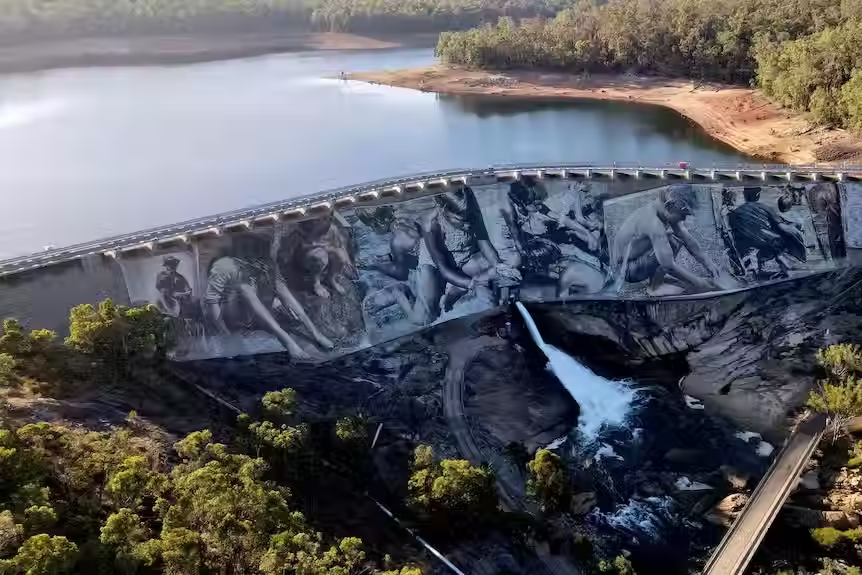
When creating Reflections on Wellington Dam in Western Australia—the world's largest dam mural covering approximately 8,000 square metres—Van Helten selected KEIM Mineral Paints specifically because of their longevity and mineral character.
Rather than masking the concrete, the paint allows the texture and history of the structure to remain visible beneath dozens of translucent layers.
The mural feels almost embedded within the dam itself.
Van Helten has spoken openly about wanting his murals to remain for generations, noting that he wants them to still exist in fifty years' time. That long-term thinking is one of the reasons KEIM's mineral technology became such an important part of the project.
In harsh Australian conditions, where intense UV exposure quickly tests conventional coatings, durability isn't simply desirable—it's essential.
Public Art That Becomes Civic Infrastructure
Increasingly, cities aren't commissioning murals as temporary decoration.
They're investing in public assets.
One of Australia's most exciting examples is the Geelong Convention and Exhibition Centre, where architecture, public art and materiality work together to create a single civic experience.
Internationally acclaimed Australian artist Rone was commissioned to create monumental artwork for the development, while KEIM mineral coatings—including Concretal-Lasur and Soldalit—were specified across architectural concrete and façade elements.
Rather than competing with the architecture, the artwork and mineral finishes share the same visual language: soft, matte surfaces that celebrate the natural qualities of concrete instead of hiding them. It's an example of public art becoming part of the architecture itself.
Likewise, projects such as 201 Ellicott Street demonstrate how mineral coatings can be used to transform buildings through colour while delivering the durability expected of long-term public assets.

Artists Around the World Are Reaching the Same Conclusion
Across Europe and North America, artists working on landmark public commissions have increasingly embraced KEIM because of its permanence and natural finish.
American muralist Eric Grohe, renowned for his monumental trompe-l'œil murals, has relied on KEIM for decades. His work has become so respected for its longevity that conservation organisations have referenced it as an example of best practice for outdoor mural creation.
For Grohe, permanence isn't an afterthought—it is part of the artwork itself.
Similarly, Erik Nicolaisen of Old City Artists has spoken about choosing KEIM because of its exceptional colour stability and the way it resists fading over time. For projects exposed to heavy public use, the addition of KEIM's anti-graffiti systems also helps protect the artwork without compromising its appearance.
In South Africa, artist Justin Venn of StudioSanctus approaches mural painting from another perspective altogether.
Inspired by centuries-old fresco traditions, Venn values KEIM because its mineral chemistry allows the artwork to become physically connected to the wall, much like historic frescoes that have survived for hundreds of years.
Although each artist has a distinct visual style, their reasoning is remarkably similar.
They aren't simply choosing paint.
They're choosing permanence.
Cities That Think Long-Term
Beyond individual artists, entire cities have recognised the value of mineral paint.
In Castellón, Spain, an open-air museum of monumental murals has been developing over several decades using KEIM mineral coatings. The collection demonstrates how public art can retain its character despite years of weather exposure, helping establish the city as an international destination for large-scale mural art.
In the United Kingdom, the Brilliant Botanicals project brought artists together to create vibrant botanical murals using KEIM mineral paints, combining artistic expression with environmentally responsible materials and exceptional durability.
These projects reinforce an important point.
The lifespan of a mural is determined long before the first brushstroke.
It begins with material selection.
Creating Work That Outlives Us
Great public art isn't measured by opening day.
It's measured by what people see ten, twenty or fifty years later.
Will the colours still feel alive?
Will the building continue telling the same story?
Will future generations experience the artwork as the artist intended?
Around the world, more muralists are answering those questions before they even begin painting.
By choosing mineral paints that chemically bond with the building, they are creating works designed not only to inspire today, but to endure tomorrow.
Because the most meaningful murals don't just decorate architecture.
They become part of it.


Comments